Friday, January 11, 2013

Old Age

Dr. Thomas Sowell

“Age gives you an excuse for not being very good at things that you were not very good at when you were young.” 

Monday, January 7, 2013

Army Writing

I discovered a handbook once published by the Army's Training and Doctrine Command called the "Action Officer's Guide: Staff Writing." It's actually a very useful little pamphlet. It's purpose was to help action officers avoid bad writing. In it, the author, a gentleman by the name of John Beckno, counsels against what is described in a politically correct manner as "bureaucratic writing." "While some bureaucratic writing is good," he says, "much of it is turgid, passive, and confusing."

He might also have added that it is 'bromidic,' 'inane,' 'boring,' 'dull,' 'stilted,' 'affected,' 'stuffy,' 'ponderous,' 'unclear,' 'leaden,' 'dismal,' 'uninteresting,' tedious,' 'monotonous,' 'dry,' 'unexciting,' 'mind-numbing,' and 'lifeless.' But then, that would have been bad staff writing.

For all we know, Mr. Beckno could have been describing a random doctrine publication; but he was, in fact, addressing all types of writing which may fall within the purview of a typical action officer.

"In spite of efforts to eradicate it," writes the expert, "poor writing still survives."

But how can this be so?

Beckno lists five reasons ...
  • "It's embedded in the bureaucracy." Embedded is the right word. It's a deep problem, part of the culture. As new people enter the service they conform to this horrible way of writing just as though they thought it mandatory, like the bad haircuts.

Saturday, January 5, 2013

Happy Birthday John -- I Wish

John H. Edinger, Jr., 1940-2010
(Photo: John H. "Jack" Edinger, III)
John would have been seventy-three years old today. I tried to always send him a card. His birthday follows so closely behind Christmas and New Years that it kind of sneaked up on me and I had to rush to find a card. As often as not, if memory serves, my card was late. 

Along with the card I also generally bought him a book. Books were about the only kind of gift from me that he appreciated. It was a challenge to find one that he had not already read or knew about. Memorable are the occasions when I got him one that he really enjoyed. He would tell me all about it, many times over the breakfast table at some greasy spoon, in Mount Airy where he lived or else here in Augusta. Whenever Connie and I visited him and Mom—or whenever the two of them visited us—John and I always went out for breakfast. It seems we did just about all our talking over sausage and eggs, grits on some mornings and hash browns on others, sometimes a little bacon, or a stack of pancakes, and gallons and gallons of coffee. 

Monday, December 17, 2012

The Latest Ridiculous Acronym from the Army

From Tom Ricks' blog ...


"Here at Best Defense we've never really gotten into VUCA, an acronym apparently developed at the Army War College to describe the "Volatile, Uncertain, Complex, Ambiguous" environment that many think we will face in coming decades. It actually brought to mind a woman I dated in my senior year of college for a few crazy weeks. It was a learning experience, OK?
"But I think the acronym-makers missed a chance here. If they added "Lethal" in the middle and "Novel" at the end, then we could face a "VULCAN" challenge."
There's something else.  In addition to the general mindlessness that produces and uses so many acronyms (then wonders why the Army is so misunderstood), there is the continued abuse of the term "environment."  That's what VUCA is all about, the VUCA environment.

For more on the overuse and misuse of the term environment, see any Army doctrinal publication.

Friday, December 14, 2012

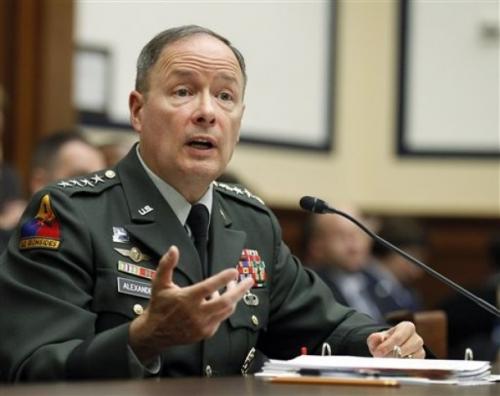
President Reagan and General Alexander on National Cyber Security

General Alexander
"In this present crisis," said President Ronald Reagan in his first inaugural address, "government is not the answer to our problem; government is the problem." Perhaps the former president's trenchant observation about the nation's economy is just as applicable to the present crisis in national cyber security.[1]

In a recent interview, General Keith Alexander, Commander, U.S. Cyber Command and Director, National Security Agency made an interesting observation. Speaking of the cyber threat to the nation, General Alexander noted that America’s adversaries “are aggressively stealing U.S. intellectual property [putting] the competitive edge of U.S. businesses at risk.” Putting it even more strongly, the general stressed that “the United States is on the losing side of the greatest transfer of wealth and treasure in history.”[2] That's the giant sucking sound you hear, unless you're completely deaf to these kinds of things.  It's happening right now as we speak.

Officers like General Alexander, and the rest of the Department of Defense in general, tend to take computer network security very seriously, apparently a lot more so than many other parts of the federal government.  The department’s emphasis on protecting our networks is keenly felt all the way down the chain of command. At Fort Gordon, for example, just this week, I and my teammates lost about 36 hours of productivity while information area security officers performed upgrades to our systems. Every year, everyone with computer access takes several hours of network security training. All of us maintain an up-to-date computer access cards, without which no access to the network is possible. Inspectors and security officers ensure that security regulations and policies are in place and closely followed. The list of security regulations, commanders' policies, training memoranda, agency updates, and "friendly reminders" are longer than a man's arm.

An awful lot of time and money are invested across the department to ensure that department employees, members of the uniformed services, and contractors know and follow all the rules. We do a pretty good job, I think, of protecting the data on our networks from ourselves—the good guys. When in the Sam Hill will the government start paying attention to people like General Alexander and get serious about protecting the nation’s data—it’s wealth and treasure—from the bad guys?
__________________________________
[1] Ronald Wilson Reagan, 1st Inaugural Address, Washington, D.C., The American Presidency Project, http://www.presidency.ucsb.edu/ws/index.php?pid=43130 (accessed 14 December 2012).
[2] Interview, General Keith B. Alexander, Military Information Technology, Vol. 16, #20, 16-19.

Thursday, December 6, 2012

What is a Field Manual?


TRADOC Regulation 25-36
"A field manual is a Department of the Army publication that contains principles, tactics, procedures, and other doctrinal information. It describes how the Army and its organizations conduct operations and train for those operations. FMs describe how the Army executes operations described in the ADPs. They fully integrate and comply with the fundamental principles in the ADPs and the tactics and principles discussed in the ADRPs."  [Emphasis added.]

To say that, under Doctrine 2015, a field manual describes "what" and an Army Techniques Publication describes "how" is to put an entirely artificial construction upon doctrine.  It is also inconsistent with the regulation that governs doctrine.


Some helpful definitions.