The National Security Agency and its Mission
The National
Security Agency (NSA) is an intelligence gathering agency of the federal
government, located at Fort Meade, Maryland, near the nation’s capitol. The NSA is actually two agencies, having
merged in 1972 with the Central Security Service (CSS) which was established to
promote a full partnership between NSA and the cryptologic elements of the
armed forces. [1]
 |
| NSA Building |
The mission of the
agency is to lead the U.S. government in cryptology that encompasses both signals
intelligence and information assurance products and services, and enables computer
network operations in order to gain a decision advantage for the nation and our
allies under all circumstances. [2]
The agency's director is uniformed military commander, presently a four-star Army general
named Keith Alexander. As head of
the NSA, his primary responsibilities are to—
- Collect (including through clandestine means), process, analyze, produce, and disseminate signals intelligence information and data for foreign intelligence and counterintelligence purposes to support national and departmental missions.
- Act as the National Manager for National Security Systems as established in law and policy, and in this capacity be responsible to the Secretary of Defense and to the Director, National Intelligence.
- Prescribe security regulations covering operating practices, including the transmission, handling, and distribution of signals intelligence and communications security material within and among the elements under control of the Director of the National Security Agency, and exercise the necessary supervisory control to ensure compliance with the regulations.
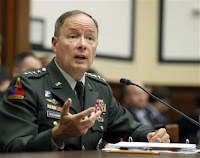 |
| General Keith Alexander |
Gen. Alexander also
wears another hat as commander of the United States Cyberspace Command
(USCYBERCOM), the headquarters of which also resides at Fort Meade. As the USCYBERCOM commander, Gen. Alexander’s
is responsible for establishing the Department of Defense’s cyberspace vision
and directing and coordinating the offensive and defensive cyberspace
capabilities of each of the service branches in support of geographical
combatant commanders.
There is a sort of
left-hand/right-hand between USCYBERCOM and the NSA. While the latter is a federal agency, the
former is an entity of the Department of Defense. The USCYBERCOM mission is to plan,
coordinate, integrate, synchronize, and direct activities [necessary] to
operate and defend Department of Defense information networks and, when
directed, conduct full-spectrum military cyberspace operations (in accordance
with all applicable laws and regulations) in order to ensure U.S. and allied
freedom of action in cyberspace, while denying the same to our adversaries. [3]

Ten years ago,
author James Bamford described the NSA as “the largest, most secretive, and
most powerful intelligence agency in the world.
With a staff of thirty-eight thousand people, it dwarfs the [Central
Intelligence Agency] in budget, manpower, and influence.” [5]
Potential for Controversy
Because of its
mission, there exists the continuing potential for embarrassment and
controversy for elected officials, especially members of Congress and the president. During the George W. Bush presidency,
especially during the dark and uncertain period of the war in Iraq prior to the
“surge” in 2006, Democrats in Congress and much of the national media became
obsessed with the NSA and its wartime mission, which was to electronically
intercept the communications of enemy combatants, even if—especially if—those
communications originated or terminated within the territorial boundaries of
the United States. Some called this eavesdropping
on American citizens. Others referred to
it domestic spying or Bush’s warrantless wiretapping program. Given that 2006 was an election year, the
left used these arguments to create an atmosphere of suspicion and distrust,
turning Bush’s use of his chief signals intelligence agency against him and
against Republicans in general. The
resulting hysteria was one of the main reasons why control of the House and
Senate that year reverted to the Democrats, and why Bush’s secretary of
defense, Donald Rumsfeld, chose to resign.
Former federal
prosecutor and National Review contributor, Andrew McCarthy, writing in the
midst of the media firestorm over Bush’s use of the NSA’s capabilities to
prosecute the war against Al Qaeda, ridiculed the arguments of the left,
showing (1) that President Bush, as commander-in-chief, in utilizing all
resources at hand to intercept enemy communications occurring domestically, was
following precedent set during the Civil War by President Lincoln and, during
World War II by President Roosevelt; and (2) that Congress, not the president,
had actually placed itself above the law in passing the Foreign Intelligence
Surveillance Act (FISA) of 1978 (signed into law by President Carter).
Arguing that “we are
either at war or we are not,” and that “if we are, the president of the United
States, whom the Constitution makes the commander-in-chief of our military
forces, is empowered to conduct the war—meaning that he has unreviewable
authority to employ all of the essential incidents of war fighting …. Not some
of them,” [6] McCarthy demonstrated that
by passing FISA, Congress made the commander-in-chief’s warfighting authority
subject to judicial review, in direct contravention of the Constitution. The left, in the run up to the 2006 elections
pumped up the notion that, by ignoring FISA (which the Bush Administration was
alleged to have done), the president was given a “blank check” with which to
prosecute the war, thereby endangering the civil liberties of all Americans,
calling the NSA program “one of the most outrageous, execrable, impeachable
acts ever committed in recorded history.” [7]
McCarthy’s central
point, in defense of Bush and the NSA, was that—
“Al Qaeda is an
international terrorist network. We cannot defeat it by conquering territory.
It has none. We cannot round up its citizens. Its allegiance is to an ideology
that makes nationality irrelevant. To defeat it and defend ourselves, we can
only acquire intelligence–intercept its communications and thwart its plans.
Nothing else will do.
“Al Qaeda seeks above all
else to strike the United States–yet again–domestically. Nothing–nothing–could
be worse for our nation and for the civil liberties of all Americans than the
terrorists’ success in that regard. For those obvious reasons, no
communications are more important to capture than those which cross our
borders. Al Qaeda cannot accomplish its ne plus ultra, massive attacks
against our domestic population centers, unless it communicates with people
here. If someone from al Qaeda is using a phone to order a pizza, we want to
know that–probable cause or not.” [8]
Check the list on the right. Mr. McCarthy is one of my counselors.
Notes.
3. Ibid.
5. James Bamford, Body of Secrets: Anatomy of the Ultra-Secret
National Security Agency From the Cold War through the Dawn of a New Century
(New York: Doubleday, 2001), front flap.
7. Ibid.
8. Ibid.
 "The Army Cyber Command announced today that it will consolidate its network operations into a 179,000-square-foot facility on Fort Gordon and bring 1,500 active-duty military, government civilian and contract personnel jobs to the Augusta area."