Showing posts with label Department of Defense. Show all posts

Wednesday, January 8, 2014

The Buzz on 'Duty: Memoirs of a Secretary at War'


I have ordered this book, part of my Christmas bonanza, Duty: Memoirs of a Secretary at War, by Robert M. Gates. I ordered it before all the published reviews of it started to appear in the press. Apparently, the book is causing quite a buzz. Here are some examples ... 

Book review: ‘Duty: Memoirs of a Secretary at War’ by Robert M. Gates, by Greg Jaffe, a reporter for the Washington Post with extensive experience covering the Pentagon. One of the better parts of Jaffe's review is what Secretary Gates had to say about the vice president ...
“I think he has been wrong on nearly every major foreign policy and national security issue over the past four decades,”
White House pushes back against claims made in former SECDEF's book, by USA Today writer, David Jackson, which relies heavily on quotes from a National Security Council spokeswoman named Caitlin Hayden. I've read and listened to a lot of, so called 'pushback' from Barack Obama since 2008, and this USA Today article is pretty weak stuff. On the Biden issue, all we're given is that the president disagrees with Gates' criticism, saying that (quoting Ms. Hayden) -
"From his leadership on the Balkans in the Senate, to his efforts to end the war in Iraq, Joe Biden has been one of the leading statesmen of his time and has helped advance America's leadership in the world. President Obama relies on his good counsel every day,"
"It is rare for a former Cabinet member, let alone a defense secretary occupying a central position in the chain of command, to publish such an antagonistic portrait of a sitting president."
And Fox News' Stuart Varney posted a brief synopsis of what seems to be a brewing storm on his Facebook page, saying -
"The Left is now in full, defensive, spin mode. Democrats take their marching orders from the New York Times, and those orders are: attack the bearer of bad news. In fact, the gates' book is devastating to the President's credibility as Commander-in-Chief, as the leader of troops he was committing to battle. His heart wasn't in it. Worse, gates writes that both Hillary Clinton and President Obama considered the surge in Iraq as mainly a political move. They weren't concerned with winning the war. They were concerned with the vote. The politics. I come from a family that for several generations, has served in the military. I am trying to put myself into the shoes of parents here, who saw their sons and daughters volunteer to fight and die, with Barack Obama as Commander-in-Chief. I would not be happy, reading that a defense secretary is calling out the president for putting politics in front of victory."
Megyn Kelly interviews Brit Hume on the subject at the Fox News website.

Commentary Magazine had this to say ...
"Unless the reporters who read advance copies of the book missed something juicier, nothing in Gates’s memoir seems likely to spoil anyone’s presidential aspirations, and I doubt Gates has any interest in doing so anyway. Picking out excerpts and anecdotes can easily skew the perception of the book, especially before the public has had a chance to read it. But the splash being made by these (mostly unsurprising) insider claims is a testament to the credibility Gates has earned over his distinguished career, and suggests the considerable authority his account of these last few years will carry."
With reviews like that out there, I'm looking forward to reading the book.

Tuesday, April 2, 2013

Teamwork: Scheduled Maintenance on an Aircraft Carrier

Just thought this was cool, the way they navigate the carrier into the drydocks.  Talk about teamwork!  It is also interesting since, just a few weeks ago, the Navy was telling us this couldn't happen -- the scheduled maintenance and overhaul of the USS Abraham Lincoln -- because of the sequester.


I wonder if anyone has ever accidently hit the accelerator right at the end instead of the brakes.

Friday, December 14, 2012

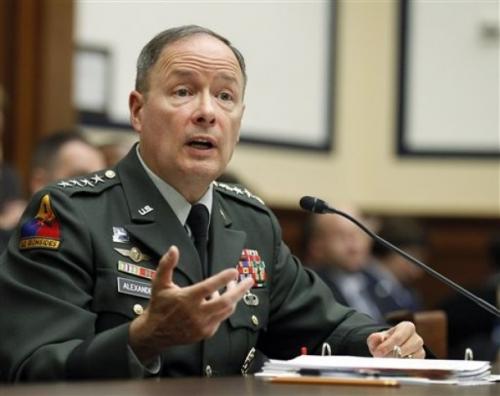
President Reagan and General Alexander on National Cyber Security

General Alexander
"In this present crisis," said President Ronald Reagan in his first inaugural address, "government is not the answer to our problem; government is the problem." Perhaps the former president's trenchant observation about the nation's economy is just as applicable to the present crisis in national cyber security.[1]

In a recent interview, General Keith Alexander, Commander, U.S. Cyber Command and Director, National Security Agency made an interesting observation. Speaking of the cyber threat to the nation, General Alexander noted that America’s adversaries “are aggressively stealing U.S. intellectual property [putting] the competitive edge of U.S. businesses at risk.” Putting it even more strongly, the general stressed that “the United States is on the losing side of the greatest transfer of wealth and treasure in history.”[2] That's the giant sucking sound you hear, unless you're completely deaf to these kinds of things.  It's happening right now as we speak.

Officers like General Alexander, and the rest of the Department of Defense in general, tend to take computer network security very seriously, apparently a lot more so than many other parts of the federal government.  The department’s emphasis on protecting our networks is keenly felt all the way down the chain of command. At Fort Gordon, for example, just this week, I and my teammates lost about 36 hours of productivity while information area security officers performed upgrades to our systems. Every year, everyone with computer access takes several hours of network security training. All of us maintain an up-to-date computer access cards, without which no access to the network is possible. Inspectors and security officers ensure that security regulations and policies are in place and closely followed. The list of security regulations, commanders' policies, training memoranda, agency updates, and "friendly reminders" are longer than a man's arm.

An awful lot of time and money are invested across the department to ensure that department employees, members of the uniformed services, and contractors know and follow all the rules. We do a pretty good job, I think, of protecting the data on our networks from ourselves—the good guys. When in the Sam Hill will the government start paying attention to people like General Alexander and get serious about protecting the nation’s data—it’s wealth and treasure—from the bad guys?
__________________________________
[1] Ronald Wilson Reagan, 1st Inaugural Address, Washington, D.C., The American Presidency Project, http://www.presidency.ucsb.edu/ws/index.php?pid=43130 (accessed 14 December 2012).
[2] Interview, General Keith B. Alexander, Military Information Technology, Vol. 16, #20, 16-19.

Tuesday, November 13, 2012

Kerry as SECDEF?

There is talk that Massachusetts Democrat Senator John Kerry, who served in Vietnam, may be nominated to succeed fellow liberal Leon Panetta as the next Secretary of Defense.  What kind of defense secretary would John Kerry be?  Democrat Senator Zell Miller (D-Georgia) clued us in on that eight years ago in a stem-winder of a speech at the 2004 Republican National Convention. The "armed with spitballs" line is in the early part of Part II.

Part I Part II

Thursday, May 17, 2012

Quote of the Day: Lt. Gen. (Ret.) Dave Deptula on Defense Spending

Lt. Gen. (Ret.) David Deptula
In a recent interview at The Foundry, Retired Air Force General Dave Deptula, who is now the chief executive officer of MAV6, LLC a a high technology company whose focus is providing situation awareness, said this ...
 “I hear people talk about, well you know, the U.S. military spends more money than the next 17 nations combined.  Well, the next 17 nations combined are not committed to maintaining peace and stability around the world. We are.” 

More here

Saturday, May 5, 2012

It's the Troops' Fault

The SECDEF
In a sign that the Obama Administration may have moved on past its propensity to blame the preceding administration for its own ineptitude, Secretary of Defense Leon Panetta, seeking to blunt media criticism of the administration's aimlessness in Afghanistan--and to divert discussion away from this administration's headlong rush to gut the military via the budget process--blames the troops.

Friday, March 30, 2012

Allen West on Military Personnel Cuts


Rep. Allen West (R-FL)

"An Army veteran serving on the House Armed Services Committee wants to cap the annual rate of reduction in the Army and Marine Corps to prevent the Defense Department from making steep reductions to save money. Representative Allen West, R-Fla., proposed Thursday to restrict the rate of decline to 15,000 people a year in the Army and 5,000 a year in the Marine Corps, essentially putting into law the controlled force reductions already planned by the two services.  In a statement, West said he worries the pace of personnel cuts could be increased to save money.
“Our men and women in the armed forces do not need to continue to be the bill payer for fiscal irresponsibility,”

For more, click here.


Friday, November 11, 2011

Defense Secretary's Veteran's Day Message ... to Congress

From the National Journal --
.... Lawmakers, Panetta said, needed to understand that U.S. troops “are willing to put their lives on the line to sacrifice for this country; you sure as hell can sacrifice to provide a little leadership to get the solution we need in order to solve this [budget] problem.”
Beats any Veterans' Day message to the troops I've heard in years.

Monday, June 6, 2011

They Shouldn't Let Him Touch it with a Ten-Foot Pole

General Cartwright
"Vice Chairman of the Joint Chiefs of Staff, General James Cartwright has commissioned a broad independent review to help the Pentagon more rapidly develop and buy urgently needed military equipment."  So begins a piece over at InsideDefense.Com, about how the Vice Chief is taking a hard look at "new ways to execute the joint requirements process" to replace the slow, bureaucratic" system known as JCIDS.  The Small Wars Journal also has a link to the piece, but theirs is accompanied by this headline:  Top Commanders Bemoan JCIDS.

JCIDS is shorthand for the Joint Capabilities Integration and Development System.

They taught us at the Army Force Management School (AFMS) that General Cartwright is considered the "father of JCIDS."

If you've ever seen this Pentagon chart, which I wrote about recently, you know a little something about JCIDS already ...

JCIDS, DAS, and PPBE
JCIDS, along with the Defense Acquisition System and the DOD's Planning, Programming, Budgeting, and Execution framework, is the process through which we get capabilities into the hands of our warfighters seven to ten years after they ask for them.

It's a system bemoaned by the military's top commanders.  It's the subject of a 4-week course at the AFMS.   Some of the instructors have had to go through the course multiple times before they could teach it.

General Cartwright is the father of it - the JCIDS part.

Again, it is a system that is bemoaned by top commanders - hence, the referenced article about General Cartwright looking at fixing it.

Look at the (JCIDS, DAS, and PPBE) chart again and ask yourself this question:  would you trust the man who gave you that to be able to fix it?

Now does that 10-foot pole make sense?

Tuesday, May 31, 2011

If You See Something, Say Something

That's the admonition we have from our government.  OK, well, try this ...

It appears that one of the benefits of ridding the planet of the obnoxious Mr. bin Laden is that we can't go to our offices anymore without proving who we are every time we go into the building--the same building we enter every day, five days a week. Every day it's like we've never been there before and it makes not difference if we've worked in that building for 25 years.  The elevated force protection measures in effect at DOD installations worldwide call for access to government buildings be granted only to those who possess a DOD-issued identification card.

This, er, precaution is believed necessary because an obnoxious devotee of the obnoxious religion of the obnoxious Mr. bin Laden might try to enter a government building and shout Islamic slogans.  (He won't be able to blow anything up because the random searches of vehicles entering the installation would have caught the obnoxious devotee and his obnoxious contraband would have been confiscated; his only recourse, therefore, would be to enter government buildings and shout obnoxious Islamic slogans).

Of course that's never going to happen, but we're going to require an ID before we let you into your own workplace anyway.  It's for your own safety.

Such is the thinking.

100% ID Card Check
So, you can imagine how tiresome this gets.  The same sergeant is on entrance duty four mornings out of five.  You're practically on a first name basis with him or her by now--unless he (or she) is the ignorant sort who keeps their nose stuck in book except to wave you through after he (or she) has checked the expiration date on your government issued ID.

I actually entered the building a few days ago and the female sergeant on duty never even looked at me.  She only broke off her thoroughly engrossing conversation with her buddy to fain checking my ID's expiration date, then went back to her thoroughly engrossing conversation.  I could have been Ayman al Zawahiri, for all she knew.

Like we (or even an obnoxious terrorist) would try to gain entry with an expired ID card!  Have you any idea how much trouble it can cause you to try to access the network with an expired computer access card--a government ID card with an embedded microchip?  Besides, using an expired ID is such an obvious, lazy way of gaining fraudulent entry.  You can't tell that the NCOs have been instructed to check expiration date.  I mean, they're not checking actual, authorized entry because they're not using access rosters.  So your name means nothing.  Only the expiration date on your card.  They will physically stop you and will not let you pass without verifying that the government-issued ID in your possession is not expired ... even after the 10th or 20th time you've accessed the same building and have been checked by the same sergeant. If the ID card wasn't expired at eight in the morning, it's not going to be expired at lunchtime.

The stated intent of the ID card check is to prevent unauthorized entry to a government facility.  I get that.  What I don't get is that, after a month now, it's pretty obvious that the folks entering the building every morning (and then re-entering after leaving for a meeting, or for an appointment, or for lunch, for crying out loud!) are authorized.  Re-checking their ID's expiration date only shows that you're too dumb to figure that out.

Not to impugn the professionalism of the NCOs required to pull card check duty.  Like the female sergeant above, most of them figured out on about day #2 that checking expiration dates is silly.  No one was any safer on any of the past 30 days because an NCO checked the IDs of everyone who entered the building.  It's officers who dream up stuff like this.

It's small stuff, agreed, and shouldn't be "sweated."  Still, it's so obviously a charade that it's insulting.

An obnoxious charade, at that.

Friday, April 8, 2011

Guidance to the DoD Workforce from Deputy Secretary of Defense

Three-page memo from the DEPSECDEF:  guidance to military and civilian employees and contractors of the DOD.  Lead paragraph reads--

"The Department remains hopeful that a government shutdown will be averted.  The president has made it clear that he does not want a government shutdown, and the Administration is working to find a solution with which all sides can agree ...."

Yeah right.

Monday, October 18, 2010

Why Are We Still Doing This?

So, the Army is sending me to this professional development class to learn about the Joint Capabilities Integration and Development System and the Acquisition Life Cycle.  Inspired by former Defense Secretary Donald H. Rumsfeld, the JCIDS is how the US military plans for and fields new capabilities.  I learned today that it takes about five years from concept to fielded capability, and that this is an improvement over the previous system.  The acquisition thing is a creature of Congress and the military bureaucracies.  Improvement, I'm betting, is not even in its lexicon.

Back in August, I heard General Pete Chiarelli, the Army's Vice Chief of Staff lament the fact that our enemies can field their capabilities a lot faster than we can.  The enemy doesn't have to abide by so many bureaucratic rules.  He doesn't have to worry about environmental policies or ensuring that minority contractors are treated fairly.  Our five year cycle is only three to him.

Now, tell me again why these two quick wars, Afghanistan and Iraq,are still not won going on ten years now?