Thursday, December 1, 2011

The National Security Agency


The National Security Agency and its Mission

The National Security Agency (NSA) is an intelligence gathering agency of the federal government, located at Fort Meade, Maryland, near the nation’s capitol.  The NSA is actually two agencies, having merged in 1972 with the Central Security Service (CSS) which was established to promote a full partnership between NSA and the cryptologic elements of the armed forces. [1]
NSA Building
The mission of the agency is to lead the U.S. government in cryptology that encompasses both signals intelligence and information assurance products and services, and enables computer network operations in order to gain a decision advantage for the nation and our allies under all circumstances. [2]

The agency's director is uniformed military commander, presently a four-star Army general named Keith Alexander.  As head of the NSA, his primary responsibilities are to—
  • Collect (including through clandestine means), process, analyze, produce, and disseminate signals intelligence information and data for foreign intelligence and counterintelligence purposes to support national and departmental missions. 
  • Act as the National Manager for National Security Systems as established in law and policy, and in this capacity be responsible to the Secretary of Defense and to the Director, National Intelligence. 
  • Prescribe security regulations covering operating practices, including the transmission, handling, and distribution of signals intelligence and communications security material within and among the elements under control of the Director of the National Security Agency, and exercise the necessary supervisory control to ensure compliance with the regulations.
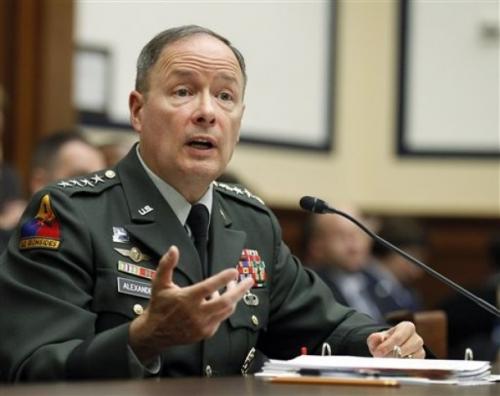
General Keith Alexander
Gen. Alexander also wears another hat as commander of the United States Cyberspace Command (USCYBERCOM), the headquarters of which also resides at Fort Meade.  As the USCYBERCOM commander, Gen. Alexander’s is responsible for establishing the Department of Defense’s cyberspace vision and directing and coordinating the offensive and defensive cyberspace capabilities of each of the service branches in support of geographical combatant commanders.

There is a sort of left-hand/right-hand between USCYBERCOM and the NSA.  While the latter is a federal agency, the former is an entity of the Department of Defense.  The USCYBERCOM mission is to plan, coordinate, integrate, synchronize, and direct activities [necessary] to operate and defend Department of Defense information networks and, when directed, conduct full-spectrum military cyberspace operations (in accordance with all applicable laws and regulations) in order to ensure U.S. and allied freedom of action in cyberspace, while denying the same to our adversaries. [3]

Ten years ago, author James Bamford described the NSA as “the largest, most secretive, and most powerful intelligence agency in the world.  With a staff of thirty-eight thousand people, it dwarfs the [Central Intelligence Agency] in budget, manpower, and influence.” [5]


Potential for Controversy

Because of its mission, there exists the continuing potential for embarrassment and controversy for elected officials, especially members of Congress and the president.  During the George W. Bush presidency, especially during the dark and uncertain period of the war in Iraq prior to the “surge” in 2006, Democrats in Congress and much of the national media became obsessed with the NSA and its wartime mission, which was to electronically intercept the communications of enemy combatants, even if—especially if—those communications originated or terminated within the territorial boundaries of the United States.  Some called this eavesdropping on American citizens.  Others referred to it domestic spying or Bush’s warrantless wiretapping program.  Given that 2006 was an election year, the left used these arguments to create an atmosphere of suspicion and distrust, turning Bush’s use of his chief signals intelligence agency against him and against Republicans in general.  The resulting hysteria was one of the main reasons why control of the House and Senate that year reverted to the Democrats, and why Bush’s secretary of defense, Donald Rumsfeld, chose to resign.

Former federal prosecutor and National Review contributor, Andrew McCarthy, writing in the midst of the media firestorm over Bush’s use of the NSA’s capabilities to prosecute the war against Al Qaeda, ridiculed the arguments of the left, showing (1) that President Bush, as commander-in-chief, in utilizing all resources at hand to intercept enemy communications occurring domestically, was following precedent set during the Civil War by President Lincoln and, during World War II by President Roosevelt; and (2) that Congress, not the president, had actually placed itself above the law in passing the Foreign Intelligence Surveillance Act (FISA) of 1978 (signed into law by President Carter). 

Arguing that “we are either at war or we are not,” and that “if we are, the president of the United States, whom the Constitution makes the commander-in-chief of our military forces, is empowered to conduct the war—meaning that he has unreviewable authority to employ all of the essential incidents of war fighting …. Not some of them,” [6]  McCarthy demonstrated that by passing FISA, Congress made the commander-in-chief’s warfighting authority subject to judicial review, in direct contravention of the Constitution.  The left, in the run up to the 2006 elections pumped up the notion that, by ignoring FISA (which the Bush Administration was alleged to have done), the president was given a “blank check” with which to prosecute the war, thereby endangering the civil liberties of all Americans, calling the NSA program “one of the most outrageous, execrable, impeachable acts ever committed in recorded history.” [7]
McCarthy’s central point, in defense of Bush and the NSA, was that—
“Al Qaeda is an international terrorist network. We cannot defeat it by conquering territory. It has none. We cannot round up its citizens. Its allegiance is to an ideology that makes nationality irrelevant. To defeat it and defend ourselves, we can only acquire intelligence–intercept its communications and thwart its plans. Nothing else will do.
“Al Qaeda seeks above all else to strike the United States–yet again–domestically. Nothing–nothing–could be worse for our nation and for the civil liberties of all Americans than the terrorists’ success in that regard. For those obvious reasons, no communications are more important to capture than those which cross our borders. Al Qaeda cannot accomplish its ne plus ultra, massive attacks against our domestic population centers, unless it communicates with people here. If someone from al Qaeda is using a phone to order a pizza, we want to know that–probable cause or not.” [8]
Check the list on the right.  Mr. McCarthy is one of my counselors.


Notes.
1.  National Security Agency website, http://www.nsa.gov/about/index.shtml (accessed November 22, 2011).
2.  National Security Agency website, http://www.nsa.gov/about/mission/index.shtml (accessed November 22, 2011).
3.  Ibid.
4.  United States Strategic Command website, http://www.stratcom.mil/factsheets/cyber_command/ (accessed November 22, 2011).
5.  James Bamford, Body of Secrets: Anatomy of the Ultra-Secret National Security Agency From the Cold War through the Dawn of a New Century (New York: Doubleday, 2001), front flap.
6.  Andrew C. McCarthy, “The Probable Cause of The NSA Controversy,” National Review Online (January 23, 2006), http://www.nationalreview.com/articles/216574/probable-cause-nsa-controversy/andrew-c-mccarthy (accessed November 22, 2011).
7.  Ibid.
8.  Ibid.  


Wednesday, November 30, 2011

The Battle of New Orleans


Battle of New Orleans
The battle of New Orleans was fought on January 8, 1815 between soldiers of the 7th U.S. Infantry Regiment, to which members of the Kentucky and Tennessee militias were attached, under the command of Major General Andrew Jackson, against British regulars under the command of Maj. Gen. Sir Edward Pakenham, brother-in-law to the Duke of Wellington.  Victory in this battle set the American commander, Jackson on the road to the White House as the nation’s 7th president.
In 1814 we took a little trip Along with Colonel Jackson down the mighty Mississip. We took a little bacon and we took a little beans
And we caught the bloody British in the town of New Orleans.[1]
The battle, contemporary with the British defeat of Napoleon at Waterloo, was the southern front of a three-front British offensive against the Americans.  The northern front was repulsed on the waterways of New York state by American naval forces.  The eastern front, however, bore some success.  The Brits sacked and burned the nation’s capitol.  Cognizant of that episode in U.S.-British relations, Prime Minister Tony Blair in his 2003 address to a joint session of Congress said that “on our way down here, Senator Frist was kind enough to show me the fireplace where, in 1814, the British had burnt the Congress Library. I know this is kind of late, but … sorry.”
We looked down the river and we see'd the British come. And there must have been a hundred of'em beatin' on the drum. They stepped so high and they made the bugles ring.
We stood by our cotton bales and didn't say a thing.
If this had been a recent battle, and McManus were writing the after action review, he might have begun his report thusly, in bottom-line-up-front fashion, “The Battle of New Orleans was a slaughter. British casualties that day numbered more than 2,000, while the Americans lost just 70 men, 13 of who were killed.”  The battle was actually the fourth skirmish between the two forces over several weeks and it actually came after a peace treaty had been signed—“in Ghent, Belgium, on Christmas Eve 1814.
Old Hickory said we could take 'em by surprise If we didn't fire our muskets 'til we looked 'em in the eye We held our fire 'til we see'd their faces well. Then we opened up with squirrel guns and really gave 'em ... well
Three things stand out about the American’s victory. First, was its unlikeliness.  Great Britain, at the time, was the world’s strongest nation.  On the fields of Europe, Britain and her allies were grinding down the forces of France, under Napoleon’s command.  Her navy rules the high seas.  And she expected revenge from having lost the American colonies in 1776.  Her soldiers were well trained, well equipped, and well fed.  The Americans, by contrast, were a hastily formed fighting force.  Jackson and his chief lieutenants had recruited much of them only the previous summer.  Moreover, only a single U.S. regiment, the U.S. 7th Infantry, was in the fight—alongside a motley contingent of “irregulars.”  The Brits looked every bit the professional army, their crisp, bright red uniforms and weaponry marking them so.  The appearance of the “dirty shirt” Americans was every bit the opposite.
We fired our guns and the British kept a'comin. There wasn't nigh as many as there was a while ago. We fired once more and they began to runnin' on Down the Mississippi to the Gulf of Mexico.
The second was the British commander’s assumption that Jackson’s forces simply would not stand and fight.  “At heart,” as McManus puts it, “the British officers apparently did not believe that a ragtag army comprised primarily of militia and backwoodsmen would stand and fight against the scarlet might of well-trained British soldiers.” 
We fired our cannon 'til the barrel melted down. So we grabbed an alligator and we fought another round. We filled his head with cannon balls, and powdered his behind And when we touched the powder off, the gator lost his mind.
The third thing that stands out about the Battle of New Orleans is that some of the American forces “know-how,” despite their inexperience, survives today in our joint military doctrine.  Says McManus, “They … proved the lethal efficacy of applied and concentrated firepower, a blend of technology, policy and tactics that would eventually prove the cornerstone of the American way of war.  One can read in Joint Publication 3-0, Joint Operations about how today’s American forces still apply these same principles
Yeah, they ran through the briars and they ran through the brambles And they ran through the bushes where a rabbit couldn't go. They ran so fast that the hounds couldn't catch 'em Down the Mississippi to the Gulf of Mexico.

Notes.

1.  Johnny Horton, “Battle of New Orleans,” Cowboy Lyrics, http://www.cowboylyrics.com/lyrics/classic-country/battle-of-new-orleans---johnny-horton-14929.html (accessed November 27, 2011).  All stanzas.
2.  John C. McManus, “Spirit of New Orleans,” Historynet, (April 29, 2008), http://www.historynet.com/
spirit-of-new-orleans.htm
(accessed November 30, 2011).
3.  Joint Publication 3-0, Joint Operations, Joint Electronic Library, http://www.dtic.mil/doctrine/
new_pubs/jp3_0.pdf
(accessed November 30, 2011).  The principles of war are explained in the first chapter.


The Essence of Doctrine 2015

The five layers of Doctrine 2015
Doctrine 2015, not in its concept but in its execution, is not much more than a huge cut and paste drill.  The concept behind Doctrine 2015 is to make doctrine more accessible and to cut down the size and number of doctrine publications.  A great idea.

In execution, however, the concept breaks down a bit

Think about it.  The Army Doctrine Publications are new, but the material in them is not--(new material on unified operations excepted).  The guts of ADP 3-0 were pasted over from the last FM 3-0.  Ditto for Army Doctrine Reference Publication 3-0 ... and for all the other ADPs and ADRPs.  There is some new material in the emerging ADP/ADRP 5-0 and 6-0 pertaining to mission command.  But this material doesn't represent the bulk of any of these pubs.  The bulk is the information that is already contained in the old FMs 5-0 and 6-0.  Hence, ADP/ADRP 5-0 and 6-0 will be, essentially, the old FMs, respectively.  It's 90% cut and paste.

Same for the field manuals.  Under Doctrine 2015 it was decided that there will be fifty FMs.  Of those fifty, for the ones that are already published as FMs, nothing changes, except maybe some of them are a little smaller now because some of their contents were cut out and pasted into some ADP or ADRP.  A lot of the old FMs, under Doctrine 2015, will become Army Techniques Publications.  Essentially, these ATPs will be cut and paste version of old FMs.

The proponents and preparing activities are cranking out a lot of work to meet Doctrine 2015 deadlines, but very little of this work is original.


twh


http://tonyhowardsblog.blogspot.com

Friday, November 11, 2011

Defense Secretary's Veteran's Day Message ... to Congress

From the National Journal --
.... Lawmakers, Panetta said, needed to understand that U.S. troops “are willing to put their lives on the line to sacrifice for this country; you sure as hell can sacrifice to provide a little leadership to get the solution we need in order to solve this [budget] problem.”
Beats any Veterans' Day message to the troops I've heard in years.

Saturday, November 5, 2011

Abuse of Imminent Domain


Supreme Court
In a course I’m enrolled in at the American Public University we were asked to discuss the relevancy of a notorious Supreme Court case, that of Kelo v. The City of New London, a case about imminent domain, to the charge that activist judges have an adverse impact on the American political system.  For a little background on the court case, there is a very brief summary posted at Heritage.Org’s blog, “The Foundry” where, on March 30, 2009, writer Conn Carroll posted the following—
“On June 23, 2005, the United States Supreme Court handed down a 5-4 decision affirming the state of Connecticut’s right to evict U.S. citizens from their homes for purposes of “economic development.” In Kelo v. City of New London, plaintiff Suzette Kelo, who had recently bought her dream home on the bank of the Thames River, sued to stop New London from using its eminent domain power to condemn and destroy her home. New London wanted to destroy Kelo’s home so that Pfizer, Inc. could build $300 million research facility.
“The government got its way. 78 homes have been destroyed. But how is that government-led economic development going? The CATO Institute has an update:”

The CATO link takes you to a You Tube video produced by the CATO Institute, a six-minute summary of the Kelo v. The City of New London decision.   I thought the Heritage blog post and the accompanying CATO Institute video might be of interest to the class.  Suzette Kelo appears in the video and there are snippets of contemporary news casts related to the story.  Here are a couple of quotes from the video …
  • “The most universally despised Supreme Court decision, perhaps in its history.”
  • “The most despised Supreme Court decision in many, many years.”
  • “Destined to be overturned.”

Justice O'Connor


My thought, after reading about the case and Justice O’Connor’s dissenting opinion, and doing some admittedly superficial research on the subject of judicial activism, is that there is probably as much “relevancy” in the Kelo case, in terms of judicial activism, as one wishes to see.  It’s like beauty in that sense, only in this case “relevancy” is in the eyes of the beholder, and this is how I tried to explain it.

Thomas Sowell
I started with Thomas Sowell, a senior fellow at the Hoover Institution at Stanford University, a towering figure in academia.  Much of his writing discusses “social issues and intellectual controversies. (1).  In his 1995 book, The Vision of the Anointed, Sowell writes that “the general process of stretching and twisting the written law—and especially the Constitution—to reach results desired by judges has been called “judicial activism.”  However, “like most phrases,” he says, “… the term ‘judicial activism’ is itself a subject to varying interpretations and distortions.” (2) 


Mark Levin
To provide a little contrast to Sowell, I turned next to Mark Levin, conservative commentator, constitutional lawyer, and president of the LandMark Legal Foundation, who has also written at some length about judicial activism.  In his 2005 book, “Men in Black: How the Supreme Court is Destroying America, Levin writes that a judicial activist is one who “construes the Constitution broadly and rejects some of its provisions outright (or gives them superficial acknowledgement) of they interfere with the desired outcome.  In essence, activist judges make, rather than interpret, the law.  They substitute their will for the judgment of deliberative bodies.  They see their role as “doing justice” or “righting wrongs” when, in fact, they’re doing neither.   As to the consequences of judicial activism, Levin cites four famous cases—the Dred Scott decision; Plessy v. Ferguson; Korematsu v. United States; and Roe v. Wade; among others. (3)

One might say of the person Levin describes that he or she “has an agenda.”  It is as if this person, because of ideology or whatever reason, is out to accomplish some end using what the general public calls judicial activism as the means to that end.  One of the first things that come to mind is FDR’s “court packing” scheme in the 1930s.  The idea was that one way to get the decisions he needed was to simply increase the size of the Supreme Court thereby giving him the opportunity put more like-minded justices on the bench.

Sowell, on the other hand, sees something else, not an agenda but an attitude, a mindset, or what he terms “the vision of the anointed;” the ‘anointed’ being the intelligentsia—in which Supreme Court justices would certainly be members.  This “vision,” he describes it, is one that is “prevailing among the intellectual and political elite of our time.” (4)  His book explores the “kind of world [that] exists inside the minds of a self-anointed elite,” but also considers carefully “how that world affects the world of reality.” (5)

*****

Noting that in different eras, different ‘visions’ compete for preeminence, in a given age and among a given people, a given vision can usually be said to ‘prevail.’  Sowell describes the common characteristics of a prevailing vision (6)—
  • “Assertions of great danger to the whole society, a danger to which the masses of people are oblivious.”  (The people of New London, they said, were ignorant of the great economic benefit that would come to them via this new industrial development for which the government must seize and destroy 78 private residences).
  • “An urgent need for action to avert impending catastrophe.”  (This was implied, in the Kelo case, with respect to the township of New London if it did not act.  It is also the searing characteristic of the 2008 bank “crisis” which led to big government’s “necessary intervention” in the form of Bush’s troubled asset relief package—TARP and Obama’s stimulus package).
  • “A need for government to drastically curtail the dangerous behavior of the many, in response to the prescient conclusions of the few.” (In Kelo, the majority of the Supremes saw steadfast belief in the constitutionally reinforced principle of the rights of private property owners as a dangerous behavior).
  • “A disdainful dismissal of arguments to the contrary as either uninformed, irresponsible, or motivated by unworthy purposes.”  (… which is pretty much how Justice O’Connor’s dissenting opinion in the Kelo case was treated). 


Sowell points out is that in our time, this type of ‘vision’ prevails among “a relatively small group of articulate people [who, because of “the rise of mass media, mass politics, and massive government”] have great leverage in determining the course taken by a whole society.” (7)  Justice O’Connor, in her dissent, seems to take Sowell’s point of view over Levin’s.  She never mentions “activist justices,” or accuses anyone in the majority of having an “agenda.”  But she does ridicule the prevailing attitude—their vision, calling the majority opinion “an abdication of our responsibility.”

As to the case’s “relevancy” to the charge of the adverse impact caused by activist judges on the American political system, it is relevant in terms of the adversity of its impact.  But I don’t consider the Kelo case an act of judicial activism.  It simply reflected the prevailing [terribly misguided] “vision” of the court—a very small group of articulate people exercising great leverage upon society and thinking the whole time they were doing what’s best for us.


***** 

Notes.

1.  Thomas Sowell, The Vision of the Anointed: Self-Congratulation as a Basis for Social Policy (New York:  Basic Books, 1995), from the short bio of Dr. Sowell that appears on the inside back cover, which also mentions Dr. Sowell’s long association with “Cornell, UCLA, Amherst, and other academic institutions and think tanks.”

2.  Ibid., 226.

3.  Mark Levin, Men in Black:  How the Supreme Court is Destroying America (Washington, D. C: Regnery Publishing, Inc., 2005), 13-14.

4.  Sowell, 2.

5.  Ibid., x.

6.  Ibid., ix-x.

7. Ibid., 5.

tonyhowardsblog.blogspot.com

Tuesday, October 25, 2011

Sunday, October 23, 2011

"The bestial nature of those ..."

President Reagan's remarks to reporters on the death of American and French military personnel in Beirut, Lebanon, October 23, 1983 ... twenty-eight years ago, today.

I'm not going to take any questions this morning because we're going right into meetings on the events that have taken place on this tragic weekend. But I would like to make this statement:
I know there are no words that can express our sorrow and grief over the loss of those splendid young men and the injury to so many others. I know there are no words, also, that can ease the burden of grief for the families of those young men.
Likewise, there are no words to properly express our outrage and, I think, the outrage of all Americans at the despicable act, following as it does on the one perpetrated several months ago, in the spring, that took the lives of scores of people at our Embassy in that same city, in Beirut.
But I think we should all recognize that these deeds make so evident the bestial nature of those who would assume power if they could have their way and drive us out of that area that we must be more determined than ever that they cannot take over that vital and strategic area of the Earth or, for that matter, any other part of the Earth.
Thank you.

Read more at the American Presidency Project:   www.presidency.ucsb.eduhttp://www.presidency.ucsb.edu/ws/index.php?pid=40673#ixzz1bdnG9o9K 


http://tonyhowardsblog.blogspot.com