Monday, December 17, 2012

The Latest Ridiculous Acronym from the Army

From Tom Ricks' blog ...


"Here at Best Defense we've never really gotten into VUCA, an acronym apparently developed at the Army War College to describe the "Volatile, Uncertain, Complex, Ambiguous" environment that many think we will face in coming decades. It actually brought to mind a woman I dated in my senior year of college for a few crazy weeks. It was a learning experience, OK?
"But I think the acronym-makers missed a chance here. If they added "Lethal" in the middle and "Novel" at the end, then we could face a "VULCAN" challenge."
There's something else.  In addition to the general mindlessness that produces and uses so many acronyms (then wonders why the Army is so misunderstood), there is the continued abuse of the term "environment."  That's what VUCA is all about, the VUCA environment.

For more on the overuse and misuse of the term environment, see any Army doctrinal publication.

Friday, December 14, 2012

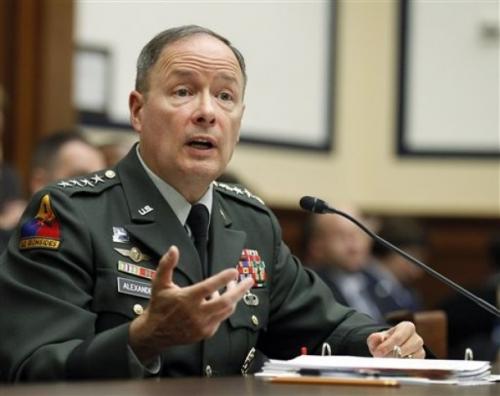
President Reagan and General Alexander on National Cyber Security

General Alexander
"In this present crisis," said President Ronald Reagan in his first inaugural address, "government is not the answer to our problem; government is the problem." Perhaps the former president's trenchant observation about the nation's economy is just as applicable to the present crisis in national cyber security.[1]

In a recent interview, General Keith Alexander, Commander, U.S. Cyber Command and Director, National Security Agency made an interesting observation. Speaking of the cyber threat to the nation, General Alexander noted that America’s adversaries “are aggressively stealing U.S. intellectual property [putting] the competitive edge of U.S. businesses at risk.” Putting it even more strongly, the general stressed that “the United States is on the losing side of the greatest transfer of wealth and treasure in history.”[2] That's the giant sucking sound you hear, unless you're completely deaf to these kinds of things.  It's happening right now as we speak.

Officers like General Alexander, and the rest of the Department of Defense in general, tend to take computer network security very seriously, apparently a lot more so than many other parts of the federal government.  The department’s emphasis on protecting our networks is keenly felt all the way down the chain of command. At Fort Gordon, for example, just this week, I and my teammates lost about 36 hours of productivity while information area security officers performed upgrades to our systems. Every year, everyone with computer access takes several hours of network security training. All of us maintain an up-to-date computer access cards, without which no access to the network is possible. Inspectors and security officers ensure that security regulations and policies are in place and closely followed. The list of security regulations, commanders' policies, training memoranda, agency updates, and "friendly reminders" are longer than a man's arm.

An awful lot of time and money are invested across the department to ensure that department employees, members of the uniformed services, and contractors know and follow all the rules. We do a pretty good job, I think, of protecting the data on our networks from ourselves—the good guys. When in the Sam Hill will the government start paying attention to people like General Alexander and get serious about protecting the nation’s data—it’s wealth and treasure—from the bad guys?
__________________________________
[1] Ronald Wilson Reagan, 1st Inaugural Address, Washington, D.C., The American Presidency Project, http://www.presidency.ucsb.edu/ws/index.php?pid=43130 (accessed 14 December 2012).
[2] Interview, General Keith B. Alexander, Military Information Technology, Vol. 16, #20, 16-19.

Thursday, December 6, 2012

What is a Field Manual?


TRADOC Regulation 25-36
"A field manual is a Department of the Army publication that contains principles, tactics, procedures, and other doctrinal information. It describes how the Army and its organizations conduct operations and train for those operations. FMs describe how the Army executes operations described in the ADPs. They fully integrate and comply with the fundamental principles in the ADPs and the tactics and principles discussed in the ADRPs."  [Emphasis added.]

To say that, under Doctrine 2015, a field manual describes "what" and an Army Techniques Publication describes "how" is to put an entirely artificial construction upon doctrine.  It is also inconsistent with the regulation that governs doctrine.


Some helpful definitions.

Sunday, December 2, 2012

Wally Aspires to be a Doctrine Writer?

The Official Dilbert Website featuring Scott Adams Dilbert strips, animations and more

Monday, November 26, 2012

Doctrine 2015's Effect on the Army Field Manual


The Doctrine 2015 framework is having an effect. That point is practically beyond dispute.  What is disputable is what, exactly that effect is.  The first thing to understand about Doctrine 2015 is that it is not about producing better doctrine. Instead, it's about revolutionizing the doctrinal publication development and dissemination paradigm.  Under Doctrine 2015, it's the process--not the product--that matters.

Mostly.

Evidence that the product is suffering may be found in talk that is common these days when the subject of the Doctrine 2015 hierarchy of publications comes up.  It is often said that field manuals are about "what" the Army does and ATPs (Army Techniques Publications) are about "how" the Army does what it does.

Which is nonsense.

Saturday, November 24, 2012

Writing Signal Doctrine

Signal is a combat support function. But don’t take my word for it. Look it up in Field Manual 3-90 Tactics, published in 2001 but still valid. The intellectual center of the Army, however, has decreed that we may no longer use the term “combat support,” but that doesn’t change the idea that signal exists to support combat. If you are doctrine writer, even though you may be prevented by the Combined Arms Doctrine Directorate at Leavenworth from describing signal as a combat support capability, you nevertheless must communicate to your target audience that signal’s entire thrust and meaning is to support the combat commander. 

As to specifically what this means, consider the following guidance from General Barry McCaffrey (U.S. Army Retired) to an infantry lieutenant about to deploy into a combat zone to lead an infantry platoon. 
“Some thoughts: 
  • Hard work saves lives. Dig, camouflage, rehearse SOPs, study, plan, train between missions. 
  • Never be surprised. ... OP/LPs ... 3-man point team ... OPSEC ... do aerial recon ... be quiet on the battlefield. 
  • Safety, safety, safety ... getting soldiers killed or maimed by accident is very painful. 
  • In contact either shoot, flank and attack, or shoot and withdraw. Always shoot ... get volume fire quickly on the enemy. Practice actions on contact before every mission. 
  • The most important weapon on the battlefield is arty/mortars ... be prepared to put HE and smoke on possible enemy locations within three minutes. We rarely know where the fire is actually coming from ... arty will let you move without casualties on the battlefield.”[1]
As a signal doctrine writer, you’ve got to understand that McCaffrey’s words apply to the signal officer just as much as they do to the young infantry lieutenant. For the signal officer, at whatever tactical echelon, must configure his communications assets in such a way that all lieutenants can execute in accordance with the general’s guidance. General McCaffrey is directing an infantry combat leader. The signal officer is enabling that same combat leader. If the field manual doesn’t capture that dynamic, it fails as a doctrinal publication. 

Or, take this example. You are writing about signal support to operations at brigade level. You might chose a Stryker brigade combat team to illustrate this. A Stryker brigade has “more than 3500 Soldiers ... and almost 2000 vehicles, including more than 300 Strykers.”[2] In Operation Iraqi Freedom, the 3rd Brigade, 2nd Infantry Division (Stryker)—also known as the “Arrowhead Brigade,” was comprised of … 
“the 5th Battalion, 20th Infantry; 1st Battalion, 23rd Infantry; 2nd Battalion, 3rd Infantry; 1st Squadron, 14th Cavalry; 1st Battalion, 37th Field Artillery; 296th Brigade Support Battalion; 334th Signal Company; 209th Military Intelligence Company; 13th Engineer Company; and Company C, 52nd Infantry (Antitank). Attached to it for the Iraq deployment are the 3rd Squadron, 17th Cavalry, 10th Mountain Division (Light Infantry), flying OH-58D Kiowa Warrior and UH-60 Black Hawk helicopters, and the 1092nd Combat Engineer Company from the West Virginia Army National Guard."[3]
Obviously, the Stryker brigade is supported by its own organic signal company, in the Arrowhead’s case by the 334th Signal Company. As the doctrine writer, you have to realize that just to say that an SBCT draws its signal support from an organic signal company is insufficient. In fact, it’s practically a waste of time because everybody already knows that. The point you have to get across to your target audience is that that signal company, with support from higher echelons where necessary, is supporting combat operations. The signal officer of a Stryker brigade supports infantry, armored cavalry, field artillery, logistical support, intelligence, engineers, and aircraft. You have to be aware that a unit like this particular SBCT may be augmented with Reserve or National Guard forces that may not be equipped, communications-wise, like their Regular Army brethren—but who still have to be supported. 

And think of signal support to large units like the 3rd Infantry Division which, during the “shock and awe phase of Operation Iraqi Freedom, sprinted “720 kilometers in twenty-one days” while firing 610 direct support, ninety counter-fire, and twenty-six reinforcing artillery missions—13,923 155mm rounds and 794 multiple-launch rocket system missiles.[4] Think of how often the division's command posts moved.  Think of the factors of METT-TC.  Sure, it’s a true statement to say that divisions have an organic signal support capability, normally in the form a division signal company. But if that’s all you can say about signal support to division operations, you haven’t learned yet what doctrine is all about. 

Doctrine is “the blueprint for forces in combat.”[5] It is the “fundamental principles by which the military forces, or elements thereof, guide their actions in support of national objectives. It is authoritative but requires judgment in application.”[6]

Signal Soldiers are not just installing, operating, maintaining, and defending the Army’s portion of the network, they are supporting military operations—chief among them, combat. 


_________________________________
[1] Barry R. McCaffrey, “Lessons in Leadership: E-mail Exchange Between The Bradley Professor and an Infantry Lieutenant,” Army Magazine, June 2005, 16. 
[2] Dennis Steele, “The Stryker: Going Up North,” Army Magazine, March 2004, 44-54. 
[3] Ibid. 
[4] Thomas G. Torrence, “The Division Artillery of the 3rd Infantry Division,” Army Magazine, April 2004, 57-60. 
[5] Rick Atkinson, Crusade: The Untold Story of the Persian Gulf War (New York: Houghton Mifflin Company, 1993), 253 
[6] Joint Publication 1-02.

Wednesday, November 21, 2012

Before Your Next Doctrine 2015 Briefing ...


10-page ADPs, 100-page ADRPs,
200-page FMs, ATPs with no size
limits, and Apps and Wikis.


          Imagine trying to explain this  >>>  


From left, Generals Bradley,
Eisenhower, and Patton


<<<  to these guys.